The Albion Dragon Path
Sacred Land, Ley Lines and Living Energy
THE DRAGON OF ALBION QUEST
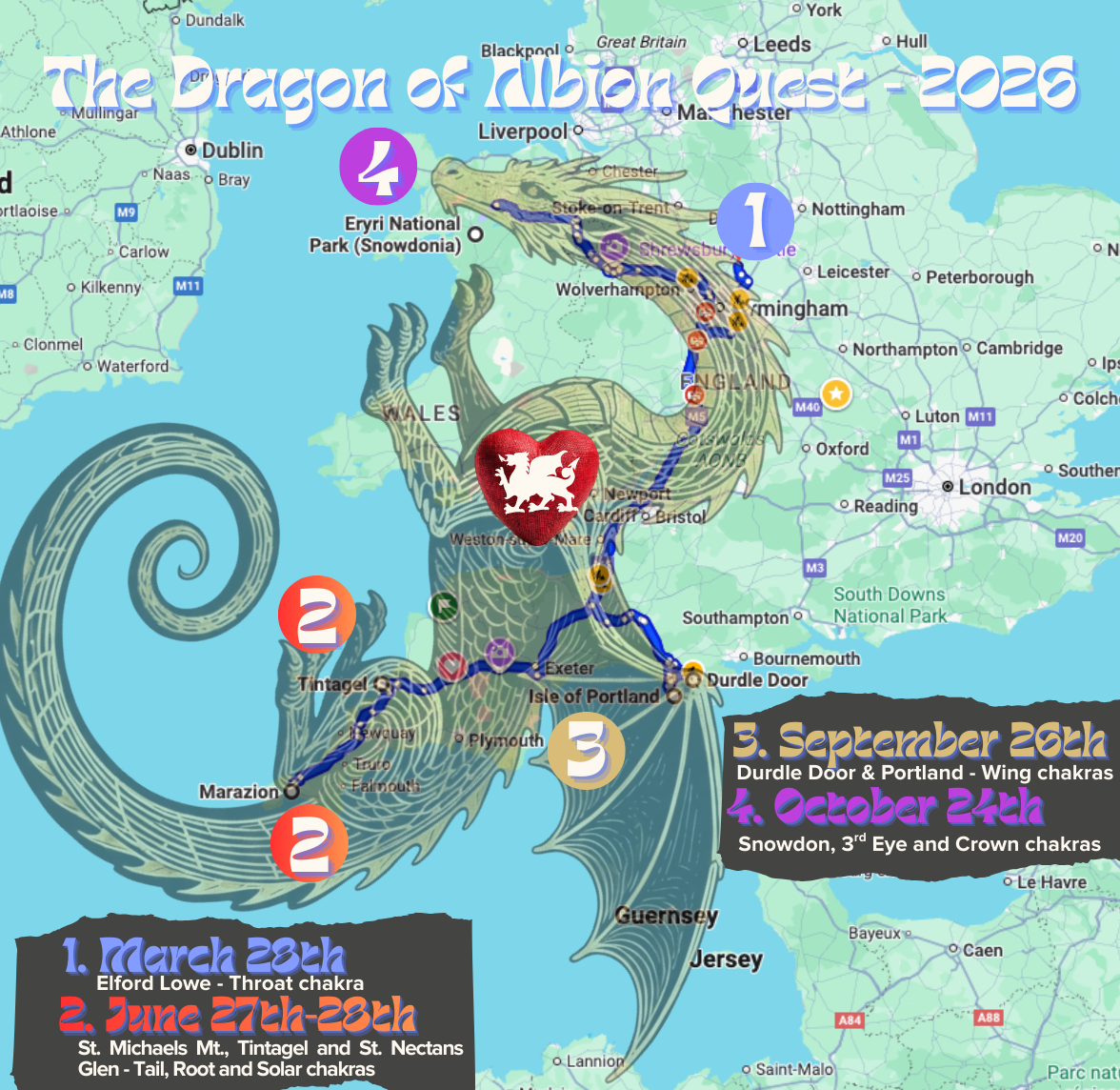
Locations of the Albion Dragon chakras.
- Elford Lowe / Litchfield (Cathedral) – Throat chakra ( March 28th )
- St. Michael's Mount – Tail chakra ( June 27th)
- Tintagel – Root chakra ( June 28th )
- Rocky Valley– Solar Plexus chakra ( June 28th )
- Southwest region (general) – Sacral chakra ( June 28th )
- Durdle Door and Portland – Wings chakra ( September 26th )
- Wales – Heart chakra ( October 24th )
- Snowdon – Third Eye and Crown chakra ( October 24th )
We will be undertaking our small section of this work, and the rest of Ireland, Northern Ireland, Wales, Scotland, and England, along with their many islands, can also contribute in their own local areas on these same dates or any other dates that suit them.
If you are outside these lands, you are warmly invited to do the same for your own local land and Dragons, right where you live.
THE ALBION DRAGON QUEST 2026
The year 2026 feels like a clear invitation from the land of Britain. In old British and Celtic lore, Albion is seen as a living being with a great dragon presence running through its hills, cliffs, mountains, and sacred sites. This dragon is both ancient and awake beneath the land, its breath felt in the winds and its memory carried in stone. When people travel across its key energetic points with intention, the dragon stirs, rises, and expresses more strongly through the land.
Our 2026 quest is to walk the chakra points of our local Dragon of Albion with ceremony and deep listening. Old lore speaks of wanderers whose footsteps retrace the dragon’s body and help awaken its full flow across the year. For us, this is a conscious pilgrimage, carried out as dragon-aligned Practitioners, Healers, Seekers, Sages, Truth-Sayers, and Guardians of the land. We move with reverence, clarity, and purpose, supporting the dragon’s energy as it strengthens through Albion.
We begin on 28th March at Elford Lowe / Litchfield (Cathedral), which aligns with the throat chakra. This centre holds voice, truth, expression, and guidance. Working here opens the dragon’s voice, allowing its message and intention to move clearly into the world. This activation sets the tone for the entire quest.
We then move, 27th June, to St Michael's Mount and the tail chakra, this is where the Dragon of Albion remembers who it is. It is the place of instinct, grounding, direction, and rising momentum. It is also a major Michael ley point where dragon and angel currents cross, which makes it a perfect meeting of earth-dragon force and celestial fire. And it has a strong connection to Mont-Saint-Michel.
The following day, 28th June, we head up the tail to Tintagel (Castle, Merlin’s Cave), which holds the root chakra of the dragon. This point anchors the dragon deep into the physical land. It carries ancient sovereignty, grounding, strength, and ancestral power. Tintagel strengthens the foundations of the dragon’s rising.
The same day, 28th June, in the afternoon, we visit Rocky Valley, the solar plexus of Albion’s dragon. This centre holds will, purpose, radiant power, and inner fire. The glen’s waterfall and spiritual lineage make it an ideal place to brighten and empower the dragon’s energy. As we journey through the southwest region, we pass through the dragon’s sacral chakra. This centre holds creativity, flow, emotion, and elemental movement. Driving through and spending time in this landscape allows us to align with and support the wider sacral field of Albion, even if we are not stopping at one single point.
Later in the year, on 26th September, we journey to Durdle Door and Portland, which align with the dragon wings chakra. These are points of movement, expansion, flight, protection, and far-reaching energy. The sea arches, cliffs and raw coastal power make them ideal for activating the dragon’s wing energy and helping the dragon open its reach across Britain and beyond.
The final major centre, 24th October, is Snowdon, which holds both the third eye and the crown of the Dragon of Albion. This mountain represents vision, intuition, higher connection, and full awakening. On the journey to Snowdon, we feel the Albion Dragon’s Heart Chakra connected to the ancient Welsh lands. Working here completes the entire chakra circuit and allows the dragon’s consciousness to rise with clarity through the whole land.
The vision is simple yet powerful. Practitioners walking and activating the dragon’s energetic centres through 2026, listening deeply, offering healing, and weaving a thread of intention across the island. Our movement strengthens the dragon’s presence and supports the New Earth frequency emerging through Albion.
Together, we act as tuning forks and guardians. We reconnect the dragon’s centres, open what is ready to open, and bring our gifts into harmony with the ancient spirit of Albion. This quest will be transformative for us, for the land and for everyone we serve.
Future: We may be visiting other areas of the UK in due course. This is the 2026 phase.
Like to join the Albion Quest?
Please provide your details and we will keep you informed..
Join the Quest ( free )
If you would love to join the full or parts of the Albion Quest, please leave your details, and we will be in touch at each stage to confirm details.
🌍✨ 2026 Dragon Pilgrimage Calendar
28 March 2026 – Elford Lowe / Litchfield (Cathedral) (Throat Chakra)
Date: 28 March 2026
Location: Elford Lowe / Litchfield (Cathedral), Staffordshire
Chakra: Throat
Sunrise: 05:46
Sunset: 18:26
Moon Phase: Waxing Crescent
Seasonal Festival: Post Spring Equinox
Notes: Easter Sunday is 5 April. New beginnings, expression, activation.
We went, we cleared, we had fun :)
_____________________________________________________
27 June 2026 – St Michael’s Mount (Tail Chakra).
See web cam: https://stmichaelsmount.co.uk/explore-the-mount/live-webcam/. We'll wave at you at 8.30 a.m. :)
Date: 27 June 2026
Location: St Michael’s Mount, Cornwall
Chakra: Tail / Base of Dragon Spine
Sunrise: 05:07
Sunset: 21:33
Moon Phase: Waxing Gibbous
Seasonal Festival: Post Summer Solstice (21 June)
Notes: Height of solar power, perfect for Earth-Dragon anchoring.
PURCHASE YOUR TICKETS: https://stmichaelsmount.co.uk/plan-your-visit/ticket-prices/
Plan ( outline ):
Meet at the causeway at the start of St. Michael's Mount, there is a car park next to it for 8.30 a.m., and walk out to St. Michaels Mt.
Visit the gardens ( ticket needed ) and walk back 11.30 at the latest before the tide rises and we get trapped ( might be a boat it you do ).
Visit local pub for lunch and chats :)
Tide times: St Michael’s Mount on Saturday 27 June 2026 using Newlyn as the tide reference harbour:
🌊 Tide times for Newlyn, 27 June 2026 Approximate predictions
- High tide about 03:40 BST height about 6 metres
- Low tide about 10:20 BST height about 6 to 1.7 metres
- High tide about 16:05 BST height about 7 to 4.8 metres
- Low tide about 22:45 BST height about 6 to 1.7 metres (tidetime.org)
St Michael’s Mount sits in Mounts Bay very close to Newlyn and Penzance, so these times are a good practical guide for planning.
🚶 When the causeway is likely to be walkable
The usual local guidance is roughly about two hours either side of low tide when the causeway is uncovered, although exact windows vary with weather, pressure and how adventurous your feet are. So for 27 June 2026 the daytime low tide around 10:20 is your main visiting window.
Very roughly, expect the best walking period to be somewhere in the band
- about 08:30 to 12:00 local time but you must check closer to the day.
⚠ Important safety note These figures are predictions only and the site I used even says they are not for navigation. (Lutterworth Sub-Aqua Club)
Before you lock in the ritual timing, I strongly recommend
- Checking official tide info for Newlyn or St Michael’s Mount a few days before
- Either on the St Michael’s Mount website
- Or via an official UK Hydrographic Office linked source
- And if in doubt, asking locals or the Mount staff on the day
For magical timing and general planning this is perfect.
For keeping your feet and drum bag dry you still want the official local call nearer the time.
NOTE: Also on: Saturday 27th June 2026 MBPGC Regatta
The annual regatta hosted by Mount's Bay Pilot Gig Club brings a lively atmosphere to the bay, as traditional racing gigs create a striking spectacle racing across the water against the backdrop of St Michael’s Mount. This event can be enjoyed from the mainland.
Location: Marazion Beach.
_____________________________________________________
28 June 2026 – Tintagel (Root), St Nectan’s Glen (Solar), Rocky Valley, SW Region (Sacral)
Date: 28 June 2026
Location: Tintagel,St Nectan’s Glen (Solar), Rocky Valley, Cornwall / Devon
Chakra: Root, Solar Plexus, Sacral
Sunrise: 05:08
Sunset: 21:33
Moon Phase: Waxing Gibbous (Full Moon on 30 June)
Seasonal Festival: Post Summer Solstice
Notes: Immense elemental energy. Perfect for grounding, courage, and creativity.
PURCHASE YOUR TICKETS:
Tintagel Castle: https://www.english-heritage.org.uk/visit/places/tintagel-castle/prices-and-opening-times
St. Nectan’s Glen - REPLACED with the Rocky Valley "Sacred Valley Portal" ( just before St. Nectan's Glen - park on the right in layby )
Plan ( outline )
Visit Tintagel - arrive 10 a.m. and then head to Rocky Valley ( see https://www.nationaltrust.org.uk/visit/cornwall/tintagel-old-post-office/rocky-valley-walk ) after lunch in Tintagel
23rd May 2026 update: Having visited recently, Merlin's cave feels awesome, so does the beach area and waterfall.
What felt off was above the beach/cave - more details on the day, though much clearing done!
Might be more a tap into the energy, I had a call with a lady working on Hawaii who's dragon form landed at Merlin Cave and went onto Glastonbury!
Let's park in the local car parks and meet at the Old Post Office opposite King Arthur's pub.
Low tide is 11.06 ( see https://tides4fishing.com/uk/england/tintagel ), so you can get to the Merlin cave if you desire :)
If people wish to explore the castle remains, please buy your tickets ( I am not personally called to go onto the rock )
_____________________________________________________
26 September 2026 – Durdle Door & Portland (Wings Chakra)
Date: 26 September 2026
Location: Durdle Door & Isle of Portland, Dorset
Chakra: Wings
Sunrise: 07:06
Sunset: 19:06
Moon Phase: Full Moon (exact day)
Seasonal Festival: Autumn Equinox (22 September)
Notes: Perfect portal for transformation, balance, wing activation, shift.
_____________________________________________________
24 October 2026 – Wales (Heart), Snowdon (Third Eye & Crown)
Date: 24 October 2026
Location: Wales and Snowdon
Chakra: Heart, Third Eye, Crown
Sunrise: 07:51
Sunset: 18:03
Moon Phase: Waxing Gibbous (Full Moon on 26 October)
Seasonal Festival: Samhain Season
Notes: Veil thinning. Powerful for ancestral work, vision, higher-realm connection.
TRAIN TICKET TO SUMMIT: https://snowdonrailway.co.uk/plan-your-visit/
Train Service ends on 25th October! And if weather poor we cannot summit and return train trip allows just 30 minutes on the summit
Questions and Answers
What is the simplest way to describe the Dragon of Albion Quest?
What is the real reason we are doing this in 2026?
What does walking the chakra points mean in practical terms?
Which part of the quest are we holding as our small section?
How do we keep the tone mystical but grounded?
What is the Albion Dragon in plain language?
If someone cannot travel, how can they take part?
What does doing your part locally look like across Ireland, Northern Ireland, Wales, Scotland, England and the islands?
What is the invitation for people outside these lands?
What should someone bring, physically and energetically?
What safety and accessibility notes do we have?
If conditions change, what is our approach?
What does a successful activation feel like?
What boundaries and principles matter most for this quest?
What is your call to action?
What can we say at the site of the Dragon?

The Albion Ley Lines and the Spine of Albion
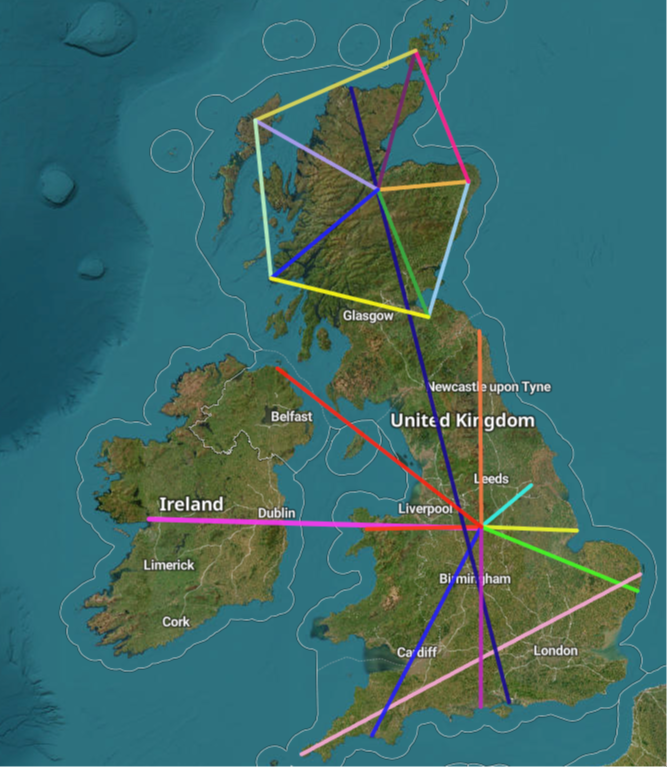
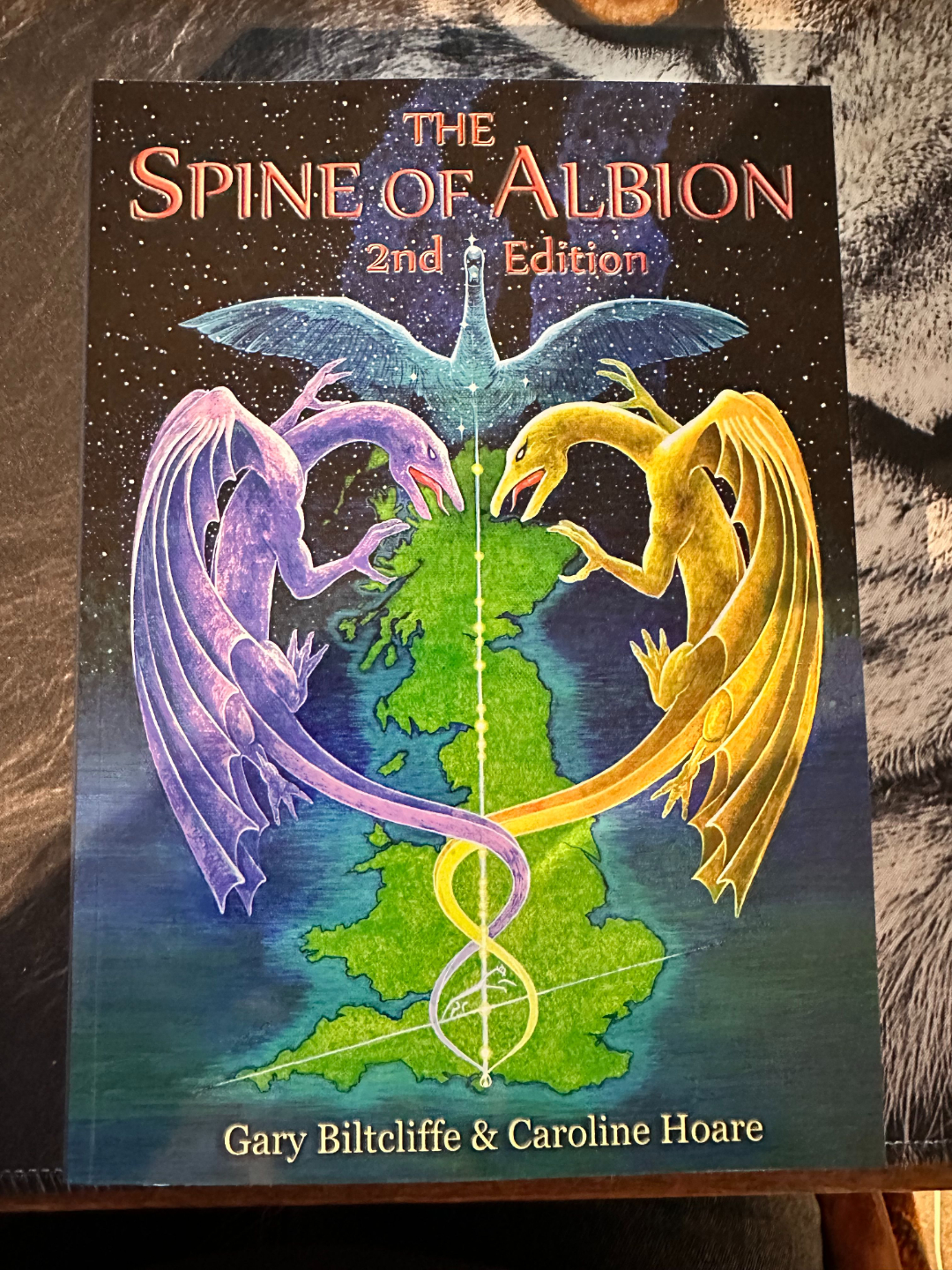
Albion is an old poetic name for Britain, and when people talk about “the Albion ley line” they often mean a specific modern spiritual map: a north-to-south axis through the heart of the land, sometimes called the Spine of Albion.
In the Spine of Albion tradition, the “line” is not described as a single pencil-thin thread. It is described as a blended central current made from two intertwined dragon currents, one often named Belinus and the other Elen. People experience them as a pair, weaving and crossing, like two great serpents moving through the backbone of the island.
A quick history of ley lines
The modern idea of ley lines in Britain is usually traced back to Alfred Watkins, a Herefordshire antiquarian. In the early 1920s, he noticed that ancient landmarks on maps appeared to form straight alignments across the countryside. He later published these ideas in 1925, using the word “leys” for these alignments and suggesting they might relate to old trade routes and sightlines, rather than anything mystical.
In the decades that followed, ley line ideas evolved in two directions.
One direction stayed practical and historical: alignments, route finding, surveying, sight lines between hills, mounds, stones, crosses and wells.
The other direction became experiential and spiritual: dowsing, earth energies, “dragon paths”, and the sense that some places are connected by a living current you can feel with your body and awareness.
By the 1960s and 1970s, writers in the earth mysteries tradition, including John Michell, helped popularise sacred landscape ideas, linking ancient sites, geometry, orientation, mythology and what some called earth energies. Around the same broad period, dowsing-based mapping became more widely shared, and “dragon lines” entered the vocabulary as a poetic way to describe how these currents feel, sinuous, alive, intelligent, and sometimes fierce.
There is also a healthy sceptical view, worth naming clearly. Archaeologists and researchers have pointed out that Britain has a very dense scatter of ancient and historic sites. If you draw enough lines across a map, some will inevitably pass through multiple sites by coincidence. So, within mainstream archaeology, ley lines are not treated as proven prehistoric planning, and many claims are considered untestable.
So, how do we hold this wisely for the Albion Dragon Quest?
Simple. We treat the Spine of Albion as a sacred narrative map. It is a way of travelling that invites direct experience, personal relationship with place, and a deeper listening with the land. It is not something you need to prove to gain value from. You walk it, you meet it, you let the land speak back.
Where the Spine of Albion starts, where it runs, where it ends
In Spine of Albion sources, the current is typically described as beginning at the Isle of Wight, then entering the mainland across the Solent and flowing north through England and on into Scotland. Different maps describe the northern reach slightly differently, but they consistently describe it continuing up through the Highlands and into the far north.
Key waypoints often named along the route include:
The Isle of Wight and the Solent crossing
The current is commonly described as beginning on the Isle of Wight. From there it is said to cross into Hampshire via the Solent, with some pilgrim routes beginning on the south coast before tracking inland towards ancient churches, wells, yews and high places.
Uffington, the White Horse, Dragon Hill and the Ridgeway
This area is frequently presented as a major power zone. In Spine of Albion descriptions, it is not just one monument; it is a whole complex: the chalk figure, the hill, the fort, the long barrow, the Ridgeway itself. In some tellings, this is also a place where other dragon currents, often called the Michael and Mary lines, interact with the local landscape, creating a multi-current node. If you want a place that feels like a ceremonial threshold between worlds, Uffington is a classic candidate.
Rollright Stones
Rollright is often presented as a key crossing zone for the paired currents. It has strong folklore, strong presence, and that “something is watching you back” sensation that makes it a brilliant stop for a quest that is part pilgrimage and part initiation.
Shap in Cumbria, sometimes called a serpent temple
Shap is frequently named as a midpoint zone on the north-south axis, with remnants of stone avenues and circles. In some accounts, it is paired symbolically with Avebury, which is often spoken about in relation to east-west currents. Shap, in the Spine of Albion language, is a spine centre, a belly of the serpent, a place where the land remembers.
The Cloud and Alderley Edge
As the current moves north, Cheshire and Staffordshire come into view in many Spine of Albion maps. The Cloud is described as a prominent hill with prehistoric associations and solar alignments observed from the surrounding towns. Alderley Edge is wrapped in myth, caves, wells, ancient trees, and the Arthurian flavour of “the king sleeping under the hill”. These are wonderful locations for telling the story of Britain as a living mythic body.
Scotland, sacred sites and the Highlands
In Scotland, some Spine of Albion materials highlight places such as Dunfermline and Clava Cairns as significant touchpoints. The broader story is that the current continues into the Highlands, with the northern end sometimes described near the far north coast.
What the Spine of Albion is for, in practice
The Spine of Albion is a quest line. It is a way of travelling that makes you slow down and notice patterns that normal tourism misses.
It is for:
-
Relationship with land. Not as scenery, as presence.
-
Remembering. Ancient sites can act like memory stones for the collective psyche.
-
Recalibration. Many people report that being in a strong place reorganises their nervous system, their intuition, and their sense of direction in life.
-
Pilgrimage with meaning. Not just where you went, but what changed in you.
How to frame it for your Albion Dragon Quest
Here’s a clean way to present it to your community:
-
The Spine of Albion is the backbone journey, south to north.
-
The blended spine is made from two intertwined currents, often described as Belinus and Elen.
-
We walk it as a lived experience, not as a debate.
-
Each stop is approached like a meeting: ask permission, listen, offer gratitude.
-
The dragon lens matters. We treat these currents as dragon ways through the land, a living intelligence you can build a relationship with.
A simple ritual format for each stop
You can give your group this repeatable structure:
-
Arrive and pause. Two minutes of silence.
-
Offer. A breath prayer, a spoken gratitude, a song, or a simple blessing.
-
Ask. “What do you want me to notice here?”
-
Listen. Watch what repeats: words, animals, sensations, memories, synchronicities.
-
Record. One paragraph in a notebook.
-
Close. Thank the place, thank the land, thank your guides, and leave it cleaner than you found it.
A respectful note
Many sites are on private land, managed estates, church grounds, or protected monuments. Always follow local guidance, opening hours, access rules, and landowner boundaries. The magic works better when you are not being chased by a disgruntled farmer, although that does add cardio.
If you want, I can turn this into a polished Kajabi page layout next, including a short version at the top, a longer deep dive below, and a “Suggested Spine Stops” section you can expand over time as your quest grows.
REFERENCE NOTES AND SOURCES USED
Ley lines: origin and evolution
Alfred Watkins and The Old Straight Track, first published in 1925. (Wikipedia)
Overview of Watkins’ early mapping observation and how the idea was later revived and debated, including a more research-minded discussion. (Alumni)
Modern sacred landscape writers and “dragon paths”
John Michell, background and his role in popularising sacred landscape ideas, including “dragon paths” language. (Wikipedia)
Mary and Michael's lines, dowsing tradition and pilgrimage framing
British Pilgrimage Trust notes the Mary and Michael lines as sensed by Hamish Miller and Paul Broadhurst, and includes a balanced “whatever you think about veracity” framing. (britishpilgrimage.org)
Spine of Albion, Belinus and Elen, start and end framing
Spine of Albion, described as the Isle of Wight to Balnakeil in Scotland, formed by paired dragon lines Belinus and Elen, credited to Gary Biltcliffe and Caroline Hoare. (Cosmic Crystal)
Tree pilgrimage article describing the Spine of Albion alignment running from the south coast through the UK, inspired by Biltcliffe and Hoare, and describing Elen and Belinus intertwining and entering the mainland from the Isle of Wight. (ancientsacredtrees)
Book listing with publication details for The Spine of Albion by Gary Biltcliffe and Caroline Hoare. (Hatchards)
Key sites commonly highlighted in Spine of Albion materials
Uffington complex and the description of Belinus and Elen crossing there, plus mention of Michael and Mary lines in that context. (belinusline.com)
Rollright Stones as a crossing zone for the paired currents. (belinusline.com)
Shap as a major node and serpent temple framing in Belinus Line materials. (belinusline.com)
The Cloud and its solar alignment observation, plus landscape significance. (belinusline.com)
Alderley Edge mythic framing and landscape features. (belinusline.com)
Scotland page highlighting example sites used in their Spine narrative. (belinusline.com)
Additional Spine narrative and site examples summarised, including Quarr Abbey, Uffington, Rollright, Shap and Scotland. (anniedieuleveut.com)
Useful reads: and website https://belinusline.com
The Dragon Line – A Comprehensive Report
Route of the Dragon Line (St. Michael Line) in the UK
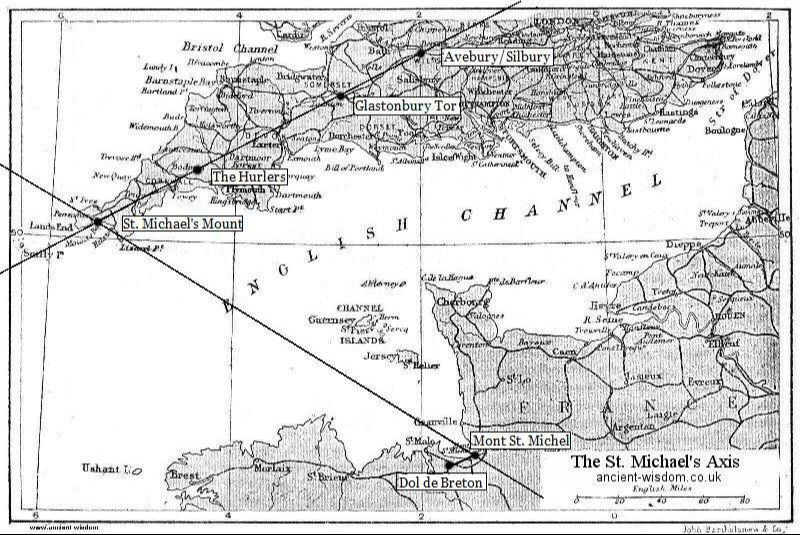
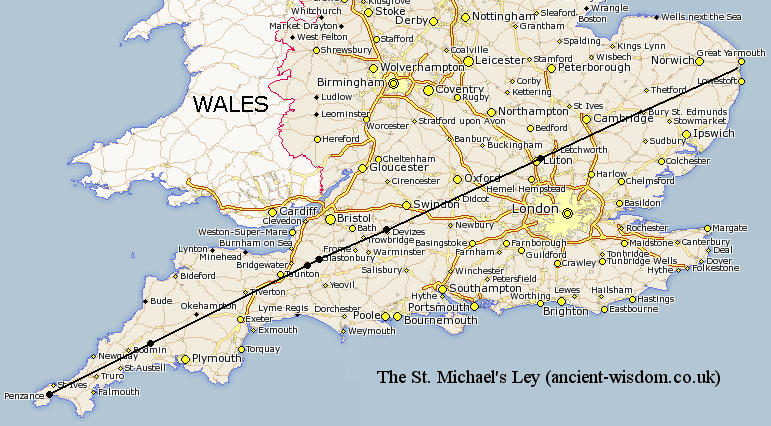
The St. Michael Line is a celebrated ley-line alignment stretching across southern England, running about 350 miles (560 km) in a straight-ish line from the extreme southwest to the eastern coast[1][2]. It effectively links St Michael’s Mount in Cornwall with Hopton-on-Sea on the Norfolk coast (near Great Yarmouth), passing through a series of renowned sacred sites along the way[1][2]. This alignment is strikingly oriented to the direction of the rising sun on May 1 (Beltane) and especially May 8, traditionally associated with St. Michael’s spring festival, hence earning its nickname “the Dragon Line” in honour of the Archangel’s victory over darkness[3][4].
Starting at the Land’s End peninsula in Cornwall – some enthusiasts even begin at the tidal islet of Carn Lês Boel at the very tip – the line runs northeast through St. Michael’s Mount, a rocky island crowned by a medieval monastery dedicated to St. Michael[5][6]. It continues over Cornwall’s ancient landscapes, intersecting neolithic sites like the Boscawen-ûn stone circle and the triple stone circles of The Hurlers on Bodmin Moor[7][5]. From there it threads across Devon via sites such as Brentor (a tor topped by a tiny St. Michael’s church)[8][9], and cuts through Somerset, aligning two prominent hills – Burrowbridge Mump and Glastonbury Tor – each capped by St. Michael’s chapels[10][11]. Further east, the line passes near Avebury in Wiltshire, the great Neolithic stone circle complex often considered the midpoint of the alignment[12][13]. Continuing into East Anglia, it is said to touch Bury St Edmunds (site of a once-major abbey) before finally reaching the North Sea at Hopton-on-Sea, close to a St. Margaret’s (formerly St. Mary’s) chapel on the coast[14][15]. Throughout this course, the St. Michael Line traces the longest straight path one can draw across England, linking high hills, prehistoric monuments, and churches in an uncanny geographic alignment[13][1].
(Major locations along the St. Michael Line in England include St Michael’s Mount, Brentor, Burrow Mump, Glastonbury Tor, the Avebury stone circle complex, and Bury St Edmunds Abbey, among others[8][16]. Many of these are visible in the map below, which also highlights how the line’s orientation corresponds to the angle of the May Day sunrise.)
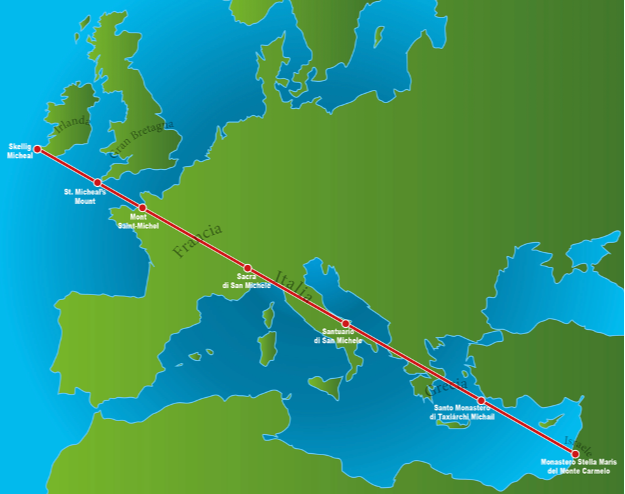
Map of the Sacred Line of St. Michael (St. Michael–Apollo Axis) running through Europe. In England this alignment (traced in the left portion of the map) begins at Skellig Michael in Ireland and St Michael’s Mount in Cornwall, and runs through sites like Mont-Saint-Michel in France and Sacra di San Michele in Italy, all the way to Mount Carmel in the Holy Land[17][18].
Sacred Sites and Significance Along the Line
Each point on the St. Michael Line is steeped in history, legend, and spiritual significance. The alignment links prehistoric sanctuaries, holy hills, ancient stone circles, sacred springs, and numerous St. Michael churches, suggesting that these locations have long been revered as power spots. For example, at the western terminus, St. Michael’s Mount in Cornwall has a 5th-century legend: in 495 AD local fishermen beheld a vision of Archangel Michael atop the crag, guiding them to safety – a miracle that established the Mount as a pilgrimage site[6]. The Mount (known in Cornish as Karrek Loos yn Koos, “grey rock in the woods”) later became a Benedictine abbey and was dubbed “the Second Rome” for the pilgrims it attracted[5]. Not far inland, the Boscawen-ûn circle and other megaliths were meeting places of bards and likely mark earth energy nodes on the Mary/Michael lines[5]. The Hurlers stone circles, which the line crosses on Bodmin Moor, carry a folk tale that they are men turned to stone for playing games on the Sabbath – an echo of the Christianisation of pagan sites[19].
Moving eastward, Brentor in Devon is another dramatic St. Michael mount: a lone church of St. Michael de Rupe perched on a volcanic tor. Local lore says a medieval nobleman built it in gratitude to St. Michael after surviving a storm at sea, fulfilling a vow to erect a church on the first land he sighted[9]. In Somerset, the pair of Burrow Mump and Glastonbury Tor forms a magical landscape. Burrow Mump (St Michael’s Borough) is a natural mound with ruins of a medieval St. Michael’s chapel on its summit[11]. Glastonbury Tor, the iconic conical hill overlooking Avalon’s vale, is crowned by the 15th-century St. Michael’s Tower, all that remains of a church toppled by a great earthquake in 1275. Myths abound here: the Tor is fabled as the Isle of Avalon, a gateway to the Otherworld ruled by the fairy king Gwyn ap Nudd, and as the place where Joseph of Arimathea hid the Holy Grail. The dedication to St. Michael – the dragon-slayer – atop Glastonbury’s sacred hill is often seen as symbolic: the Archangel’s chapel was deliberately placed on a potent pagan power-centre to spiritually “tame” the older energies[20]. Indeed, early medieval Christians built many St. Michael churches on hilltops, viewing Michael as a protector who subdues ley-line “dragon forces” that pagan peoples had revered[20][21].
Near the midpoint of the line, Avebury in Wiltshire marks a major concentration of prehistoric sites. The vast Avebury stone circle – the largest in the world – lies exactly halfway along the St. Michael alignment[12]. Here the Michael and Mary energy currents intertwine dramatically (as described in The Sun and the Serpent), crossing at features like The Sanctuary and winding through Silbury Hill, West Kennet Long Barrow, and Avebury’s avenues[22][23]. Folklore already regarded Avebury’s serpent-like layout as a “temple of the serpent” even before Miller and Broadhurst’s dowsing work[13]. The presence of St. Michael’s churches in nearby villages (such as Ogbourne St. George and West Overton) further highlights the blend of Christian and pre-Christian significance in this landscape[24][25].
In the eastern counties, the alignment passes through Ogbourne St. George (where a church of St. George – another dragon-slayer – sits on the line, complete with a pagan sheela-na-gig carving[25]) and on towards the Fens. In Bury St. Edmunds, once among England’s grandest abbeys, the line intersects a former shrine of St. Edmund (a Saxon martyr-king) and a nearby medieval St. Mary’s Church. Finally, at Hopton-on-Sea by the Norfolk/Suffolk coast, the line ends near a little clifftop church (St. Margaret’s) and perhaps once aligned with a lost chapel to St. Mary by the dunes[15]. The trajectory, if extended into the North Sea, intriguingly points toward the sunken lands of Doggerland, inspiring speculation that this “Michael line” might once have continued through a prehistoric landscape now under water[26]. Whether or not one accepts such speculation, it is undeniable that the sites along the St. Michael Line – be they stone circles, holy wells (such as Chalice Well at Glastonbury or St Neot’s Well in Cornwall), or storied hilltop chapels – have accumulated layers of myth and sacred tradition over the centuries. Each stop has its legends, saintly apparitions, dragon-slaying tales, or healing traditions, making the journey along the line a rich tapestry of British spiritual heritage[5][27].
The Michael–Mary Energy Currents (The “Sun and the Serpent”)
Underlying the straight-line alignment of the St. Michael Line is a subtler dance of earth energies often personified as male and female currents. Dowsers Hamish Miller and Paul Broadhurst famously investigated this in the 1980s, culminating in their 1989 book The Sun and the Serpent[28][29]. According to their findings, two energy currents snake along the alignment: a “Michael” current and a “Mary” current – one viewed as solar/masculine and the other as lunar/feminine[30]. Rather than one perfectly straight line, Miller and Broadhurst found that the Michael current undulates gently but keeps a generally straight course, often running along high ridges, hilltops and places associated with the sun (e.g. promontories, rocky tors). In contrast, the Mary current weaves more sinuously across the landscape, gravitating to springs, holy wells, and valley bottoms before rejoining Michael at node points[30][31]. The two currents cross each other at numerous locations – notably at many sanctuaries along the alignment – creating what dowsers identify as energy nodes or vortices. Every place where Michael and Mary intersect was found to correspond with a sacred site: for example, they converge at Glastonbury Tor, at Avebury (where they cross within the Avebury stone circle), at Burrowbridge Mump, at the Hurlers stone circles, and even at the underground Royston Cave in Hertfordshire[29][32]. At these nodes, the combined energies were said to produce a heightened spiritual atmosphere or “serpent power,” which ancient builders apparently recognised and marked with temples, stones, or churches[31][33].
Miller and Broadhurst gave poetic life to these currents by naming them after St. Michael and St. Mary – the dragon-slaying archangel and the divine feminine figure – suggesting that Britain’s sacred landscape was deliberately tuned by ancient peoples to balance male and female energies. They noted that many key points on the Michael current have churches dedicated to either St. Michael or to St. George (another mythical dragon-slayer), whereas along the Mary current one often finds sites dedicated to the Virgin Mary or to water nymphs and goddesses in pre-Christian times[31][28]. This led to the idea that the “Mary and Michael Pilgrims’ Way” can be walked as a pilgrimage balancing the yin and yang of the land. The authors also discovered that the currents swell in intensity at certain times of year. Specifically, the Michael current was strongest around the cross-quarter days (especially Beltane in early May and Samhain in late October), suggesting a link with solar festivals, whereas the Mary current was felt to respond to lunar cycles[28][34]. They theorised that a “lost science” once understood how to harness these energies – for example, lighting beacons along the Michael line at Beltane sunrise to amplify fertility and vitality across the landscape[4][34]. While such claims remain unproven, Miller and Broadhurst’s work significantly popularised the St. Michael Line’s mystical reputation. Today, many dowsers follow in their footsteps, rods in hand, tracing the serpentine paths of Michael and Mary as they wind from Cornwall to Norfolk[29][32].
The St. Michael–Apollo Axis Across Europe
The St. Michael Line of England is often seen as part of a greater pan-European alignment known as the “St. Michael–Apollo Axis” or the “Sword of St. Michael.” This is an imagined straight line (or great-circle arc) connecting a series of sanctuaries dedicated to St. Michael the Archangel (in Western Europe) and to Apollo (in Greece), running diagonally across the map from northwest Ireland all the way to Israel[35][36]. Remarkably, if one extends a line from Skellig Michael – the jagged monastic rock off Ireland’s coast – through St. Michael’s Mount in Cornwall and onward, it passes through Mont-Saint-Michel in France, then the Sacra di San Michele in the Italian Alps, and onward through Greece to Mount Carmel in the Holy Land[17][18]. Many of these sites share the 60-degree orientation of the English line (roughly northeast-southwest), prompting theories that they were purposely aligned. In legend, this axis is the sword stroke of St. Michael, casting the Devil out of Heaven and cutting across Europe’s surface.
Key points on the Michael–Apollo Axis include:
- Skellig Michael (Ireland): A remote pinnacle of rock hosting a 6th-century monastery, named for St. Michael. It marks the northwestern terminus of the alignment in some interpretations[17]. Monks here lived in beehive huts atop the crag, devoting their solitude to Michael the protector.
- St. Michael’s Mount (England): The English starting point of the line (already described), twinned legend-wise with Mont-Saint-Michel. Both are tidal islands with early Michael chapels.
- Mont-Saint-Michel (France): The iconic island abbey off Normandy, founded after Archangel Michael appeared in 708 AD to St. Aubert, the Bishop of Avranches. Mont-Saint-Michel’s gilded statue of St. Michael defeating the dragon crowns its spire. Notably, Mont-Saint-Michel, the Sacra di San Michele, and Monte Sant’Angelo (see below) lie equidistant from one another along this line, a fact often cited as evidence of intentional sacred geography[37].
- Sacra di San Michele (Italy): A majestic monastery perched on Mount Pirchiriano in Piedmont, founded around 1000 AD, exactly halfway between Mont-Saint-Michel and Monte Sant’Angelo[37]. The Sacra’s dedication to St. Michael and commanding mountaintop position make it a crucial link in the chain. According to tradition, it was placed here because of the alignment – the monks consciously aligning their abbey with the two older Michael shrines to north and south.
- Sanctuary of Monte Sant’Angelo (Italy): Located in Gargano, southern Italy, this shrine marks the site of St. Michael’s earliest apparition in Europe (490 AD, to the bishop of Sipontum in a cave). It has been a major pilgrimage site since the early Middle Ages. Monte Sant’Angelo’s sanctuary lies on the same alignment and forms the southern anchor in Europe[17]. A pilgrimage route known as the Via Sacra Langobardorum connected it with Rome and beyond, highlighting its importance.
- Delphi (Greece): While not a Christian site, Delphi – the prime oracle of Apollo in ancient Greece – is often noted to fall near this extended line[36]. In fact, French researcher Jean Richer found that Delphi, Delos, and Athens (all Apollo-related sites) align on a similar bearing[38][39]. When that line is extended, it converges with the Michael line, suggesting a continuous Apollo–Michael axis bridging pagan and Christian sacred geography. Apollo, the sun god who slew the Python (dragon) at Delphi, is thus intriguingly mapped in line with Michael the dragon-slayer – a symbolic alignment of mythic parallels across cultures.
- Panormitis Monastery, Symi (Greece): A Greek Orthodox monastery of the Archangel Michael on Symi Island also stands on the axis, further cementing the Archangel’s trail toward the east[18].
- Mount Carmel (Israel): The line (sometimes said to end here) reaches Mount Carmel on the Mediterranean. On its slopes is the Stella Maris Monastery, a Carmelite church dedicated to the Virgin Mary but often included as the final point of the St. Michael line[18]. Mount Carmel has ancient prophetic significance (site of Elijah’s contest) and lies due north of Jerusalem. Some legends say the line “points” to Jerusalem or Armageddon (Megiddo) as well[40], giving a millenarian flourish to the concept.
Proponents of the St. Michael–Apollo axis marvel at how straight these points lie in relation to each other, claiming the odds of seven major sanctuaries aligning by chance are astronomical. They also note the geomantic symbolism: all the Michael shrines sit on prominent heights or islands (hard-to-reach “high places” traditionally linked with sky gods)[17], and many were built atop older pagan sites – suggesting a continuity of sacred locations on the same earth meridian. Critics, of course, argue that with hundreds of Michael churches and Apollo temples across Europe, some will inevitably form lines by random chance. Yet the 60° angle of this axis (roughly NW-SE) is compelling: it corresponds to a rhumb line that navigation in antiquity might have followed[41]. Indeed, one astrophysicist calculated that the best-fit great circle through these sites deviates only a few kilometres over thousands of kilometres – “astonishing” precision if unplanned[41]. Whether by design or coincidence, the St. Michael–Apollo axis has captured the imagination as a sacred geometry of Europe, linking the Atlantic fringes to the cradle of civilisation in a single straight path. Pilgrims and researchers like Hamish Miller have even extended their journeys along this axis – Miller and his colleagues recounted an “odyssey” following the Great Dragon line from Ireland to Israel in their book The Dance of the Dragon, exploring how European and Near Eastern sacred sites resonate along one continuum[42][43].
Researchers’ Interpretations and Sacred Geometry
The idea of the St. Michael Line (and ley lines in general) has attracted a host of interpretations from authors in the “Earth Mysteries” field. When Alfred Watkins first introduced ley lines in 1925, he saw them as straight trackways or alignments of ancient markers, possibly trade routes or sight-lines used in neolithic navigation[44][45]. However, later writers like John Michell radically reinterpreted leys as vestiges of a prehistoric spiritual science. In his seminal book The View Over Atlantis (1969), Michell highlighted the St. Michael Line as “remarkable for its length and accuracy,” noting how Glastonbury Tor and Burrow Mump – two engineered-looking hills with St. Michael churches – align perfectly, and how that axis extends across the country[46][10]. Michell believed this was no accident: he argued that ancient druids or architects deliberately sited stone circles and mounds on energy-rich alignments to harmonise with celestial events (like the solstice or in this case cross-quarter sunrise)[47]. He spoke of “dragon sites” along the line and suggested that the very shaping of hills and placement of monoliths reflected a sacred geometry known to our ancestors[46]. Michell’s ideas, though unorthodox, fired public imagination and ushered in the notion that leys carry earth energies or dragon currents, later explored through dowsing.
Hamish Miller and Paul Broadhurst, as discussed, expanded on Michell’s vision by adding the concept of intertwining male/female energy streams. They viewed the Mary and Michael lines as a Yin-Yang pair akin to serpents twining around a caduceus, bringing vitality to the land. Their dowsing-led interpretation imbued the alignment with a dynamic, biophysical reality – not just an abstract straight line on a map, but a flowing current one can feel with rods or intuition[30][29]. They also posited a conscious intent by megalith builders to “tune” sites to these currents. For example, they noted that many standing stones at crossover points have quartz or magnetic properties, which might interact with the earth’s magnetic field[48][49]. Although not scientifically verified, this hints at a proto-scientific understanding (or at least a sensitive intuition) of geophysical forces among ancient people. Broadhurst and Miller even mused that the landscape temple along the Michael line was used to fertilise the earth – literally injecting life force at Beltane and Lughnasadh to boost crops and herds[50]. In their view, Christian figureheads like St. Michael and St. Mary “inherited” these pagan power sites, and the churches simply continued the charge, albeit under a new religious guise.
Another researcher, Peter Dawkins, approaches these alignments through a lens of geomancy and sacred geometry. Dawkins sees the Michael line as part of a larger “Landscape Zodiac” and a network of chakras in the earth. He notes that Britain’s “heart centre” corresponds to the area around Glastonbury and Avebury – fittingly where the Michael and Mary lines cross most intensely – and considers this no coincidence[51][52]. In the landscape zodiac concept, each region of Britain corresponds to a zodiac sign, and the Michael line happens to traverse several key “chakra” points, potentially acting as the spine or axis of an energetic system. Dawkins and others also emphasize the geometry of distance: the equidistance of major Michael sites in Europe (as mentioned, Mont-Saint-Michel, Sacra, and Gargano are spaced in a straight line, equal distances apart[37]) suggests intentional planning at a grand scale – or a “sacred geography” principle at work, as Jean Richer proposed[53][54]. Richer’s own discovery that Apollo temples from Corfu to Delos lined up set the precedent that ancient architects did encode alignments over vast distances[38]. Authors like Paul Devereux have alternatively explored whether ley lines might correspond to paths of consciousness or even acoustic/electromagnetic anomalies, linking the Michael line to phenomena like earth lights or UFO sightings (as Aime Michel did in the 1950s)[55][56]. While these fringe theories range from the poetic to the pseudoscientific, they collectively treat the St. Michael Line as more than an arbitrary straight line: instead, as a deliberate construct of sacred geometry, aligning human ritual sites with natural earth energies and celestial events. The very straightness of the alignment is sometimes seen as a symbol – a “sword” dividing light and dark – or as part of a grid of ley lines that criss-cross the globe in geometric patterns (e.g. great circles, Platonic solids inscribed in the earth)[57][58]. In summary, researchers interpret the Dragon Line through varied frameworks – mystical, geomantic, historical – but nearly all agree it represents a profound integration of landscape, legend, and geometry, inviting us to view the land as a living, interconnected whole.
Global “Dragon Lines” and Analogous Energy Grids
The concept of dragon lines on the St. Michael alignment resonates strongly with similar beliefs in other cultures about earth energy meridians. The very term “dragon line” is derived from the Chinese notion of lung mei (dragon currents) in feng shui, where the landscape’s features are likened to a dragon’s body and harmonious sites are located on the dragon’s veins. In Chinese geomancy, important structures (tombs, temples, cities) were sited along these invisible lines to tap into auspicious earth energy. The St. Michael Line’s straight traversal of hilltops and mounds, and its association with a dragon-slaying archangel, is a Western echo of this idea – taming or harnessing the dragon power of the land[20][21]. Indeed, some feng shui practitioners have taken interest in the Michael line as a potent “Western dragon current.”
Indigenous traditions also speak of spirit lines across the land. In Aboriginal Australian culture, the Songlines or Dreaming Tracks criss-cross the continent: they are mythic paths walked by creator-beings, and Aboriginal peoples navigate and perform ceremonies along these routes. Songlines are not straight per se, but they function as spiritual energy lines connecting sacred points (waterholes, rocks, etc.), similar in concept to ley lines[56]. The idea that singing the land along a line can keep it alive has a poetic parallel to the modern practice of meditating or dowsing along the Michael line to “energise” the earth. In the Americas, the Inca spoke of ceques, radiating ritual lines out of Cuzco that connected temples and huacas (holy places) in the landscape[59]. This mirrors how the Michael line links numerous holy sites in a linear arrangement. Ancient straight roads like the Nazca lines of Peru or the prehistoric Hopewell roads in North America are also often brought into the conversation, though their purposes differ, they demonstrate a human tendency to impose linear patterns on sacred landscapes[59][60].
Perhaps most striking are modern theories of global energy leys. One influential idea (popularised by researchers like Robert Coon) is that two great serpentine energy lines encircle the globe, intersecting at major world power spots. These are sometimes called the “Rainbow Serpent” (feminine energy line) and the “Plumed Serpent” or dragon line (masculine energy line)[51][61]. According to this concept, the segment of the female Rainbow Serpent line passes directly through England, and is in fact identified with the Michael/Mary alignment – hence the St. Michael Line is part of a global energy artery that continues far beyond Norfolk and Cornwall[51][62]. Coon’s map of the world’s “12 spiritual chakras” placed Glastonbury/Avebury as the Heart Chakra of the planet, through which the Rainbow Serpent line flows[61][63]. This female line is said to begin near Uluru in Australia, wind through southeast Asia, cross Glastonbury, then go under the Atlantic and emerge in the Andes (hence connecting to places like Lake Titicaca)[51][64]. The Michael line in Britain corresponds to this female dragon current’s path, being “highly active on May Day sunrise” and entering Britain at St. Michael’s Mount[62]. Meanwhile, a complementary male great line is envisaged to run differently (often cited through places like Giza and Mt. Kailash). While scientifically unprovable, these global dragon line theories richly extend the Michael line’s significance: rather than an isolated quirk of British geography, it becomes one strand in a planetary web of energy. Supporters of this view often note that many renowned sacred sites worldwide (the Great Pyramid, Machu Picchu, etc.) lie on great circles or antipodal alignments, implying a global sacred geometry by which the Michael line is but one piece.
Even outside these grand theories, the analogy of “ley lines” appears worldwide. For example, in Ireland, folk traditions talk of “fairy paths” – straight invisible tracks which one mustn’t block, as they’re trod by the Sidhe (spirits). In India, certain temple networks align regionally on pilgrimage routes that echo ancient solar axes. And on the esoteric side, modern mystics speak of an Earth energy grid (sometimes called the “world grid”) of 12 or more great circles and nodal points (the Michael line is often included in such grids)[65][45]. The prevalence of dragon/serpent imagery – from the feathered serpent Quetzalcoatl in Mesoamerica to the Rainbow Snake of Aboriginal myths – further suggests a universal archetype of the telluric dragon, the spirit of the land’s energy which humans seek to propitiate or channel. In summary, the St. Michael Line’s concept dovetails with many global traditions: Chinese geomancy’s dragon lines, Aboriginal Songlines, Inca ceques, and New Age planetary grids all point to a belief that the Earth has unseen energetic pathways. The “Dragon Line” of St. Michael is thus often seen as the European branch of a much larger mystical framework – one that imagines our planet criss-crossed by living currents that connect sacred sites in a grand tapestry.
Modern Pilgrimages and Practices on the St. Michael Line
In recent decades the St. Michael Line has experienced a renaissance as a route for spiritual pilgrimage and contemporary ritual. What began as antiquarian speculation is now a practical journey that many undertake on foot, seeking personal transformation and connection with the sacred landscape. Several organisations and authors have mapped walking itineraries following the Michael and Mary currents. Notably, the Mary Michael Pilgrims’ Way is a 350-mile long-distance walking route from Cornwall to East Anglia, divided into sections for those who wish to “walk the dragon”. The British Pilgrimage Trust has promoted this route, pointing out how it “passes through a surprising density of extraordinary holy places” and inviting pilgrims of all faiths or none to experience its potency[66][5]. Guidebooks now list chapels, stone circles, holy wells, hillforts, and churches along the way, offering reflections and historical notes for each. Many walkers treat it as a five-week journey akin to a British Camino de Santiago, while others visit select points on weekends. There are even cycle routes paralleling it for biking pilgrims[67][68]. At Glastonbury Tor, the National Trust has installed a direction plaque that marks the line as the “Dragon Path”, acknowledging the alignment officially[69]. It’s not uncommon to find offerings of flowers or ribbons at sites like the Chalice Well in Glastonbury or people dowsing for the currents on top of the Tor, especially around the time of Beltane (May 1) when the sunrise famously illuminates the line[4]. Groups sometimes gather on May Day morning at St Michael’s Tower on the Tor to greet the sun and symbolically “activate” the Michael line with meditation, chants or ringing of bells – a nod to the supposed Beltane beacon fires of old[4].
Various New Age and neo-Druid ceremonies have also become associated with the line. At the major node points (for instance, where Michael and Mary currents cross), one might encounter ceremonies at summer solstice or equinox. Avebury sees druids and pagans assembling in the stone circles to celebrate the turning of the wheel of the year, often with an awareness that the Michael line energy is part of the sanctity of the site. Glastonbury’s Chalice Well hosts peace meditations and full-moon gatherings, aligning with the gentle Mary current there. In Cornwall, local pagan groups have occasionally organized “dragon walks” tracing the line over the moors, stopping at sites like Boscawen-ûn or St. Cleer’s Well to give offerings to the land and to Archangel Michael seen as the guardian of the West. The line has also inspired artistic and musical work – for example, a choral piece titled “The Michael Line” was once performed inside Royston Cave, whose mysterious carvings lie at an intersection of the currents[32]. The cave, long speculated to have Templar connections, now sees both curious tourists and ley-hunters paying respects to what they feel is a tangible node of earth force beneath the town.
Importantly, the revival of pilgrimage along the St. Michael Line is inclusive and interfaith. People from Christian backgrounds may walk it as a traditional pilgrimage from St Michael’s Mount (once a great medieval pilgrimage site) to Avebury or Bury, honouring the Archangel at each Michael church. Meanwhile, those of a Goddess spirituality focus might follow the Mary line to holy springs dedicated to Mary or Brigid, or to sites of the “Earth mother” (for instance, the tumuli and fertility symbols along the route)[70]. Many simply undertake it as a journey of self-discovery, drawn by the landscape’s beauty and the lore. The route crosses a rich variety of English scenery – wild Cornish cliffs, the moors of Dartmoor, quiet Somerset waterways, and the rolling downs of Wiltshire – which in itself provides a form of spiritual nourishment[71][5]. Pilgrims often speak of a deepening connection to the land and uncanny moments of synchronicity when following the line. It’s not unusual to meet fellow travellers who spontaneously join a segment, sharing stories of why they felt “called” to the journey.
In addition to walking, some modern practitioners engage in geomantic healing on the St. Michael Line. They might perform rituals to “heal” or balance the energies at certain points – for example, if a point on the Mary line is on private land or disrupted, dowsers may do distance work to reconnect the flow. Others undertake “dragon quests” – meditations meant to communicate with the spirit of the dragon line, much as one might engage with Kundalini energy within the body. On a more everyday level, local church communities along the line (several of which are still dedicated to St. Michael) have begun to recognise the influx of pilgrims. Some churches now keep their doors open and offer “pilgrim stamps” (as one would collect on the Camino) for those with a Mary/Michael credential or passport. At St. Michael’s Church on Glastonbury Tor, although long ruined, a small plaque tells of the Tor’s alignment with St Michael’s Mount and other sites – lending a sense of authenticity to what was once a fringe idea[69].
In summary, the St. Michael (Dragon) Line today is alive with activity: a path where myth meets the modern seeker. Its straight track guides people not just geographically across England but also on an inner journey through layers of history and spirituality. From scholarly ley-hunters and dowsers, to Christian devotees of St. Michael, to neopagan celebrants of the Earth, all find something on the line. As one recent travel writer observed, “you can’t fail to be impressed that the line stretches more or less straight from St Michael’s Mount to Hopton-on-Sea… following it, one senses a purpose to the procession of sacred places”[72]. Whether that purpose was placed by ancient design or by cosmic coincidence, the Dragon Line continues to inspire pilgrimage, imagination, and reverence – a testament to the enduring mystique of the sacred landscape of Britain.
References:
- Miller, Hamish & Broadhurst, Paul. The Sun and the Serpent. MYTHOS, 1990. (Documenting the dowsing of the Michael and Mary lines)[29][32].
- Michell, John. The View Over Atlantis. Sago Press, 1969. (Influential work reviving ley line lore, with discussion of the St. Michael alignment)[46][47].
- Saint Michael’s Line – Wikipedia: “Mary & Michael Pilgrims’ Way”. (Overview of the English ley line and its sites)[73][74].
- Jacobs, Frank. “St. Michael Alignment: England’s Most Famous Ley Line.” Big Think – Strange Maps, 16 Aug 2011[1][7].
- Royston Cave official site – “The Mary and Michael Ley Lines”. (Background on the currents and global parallels)[2][56].
- British Pilgrimage Trust – Mary & Michael Pilgrims’ Way (online guide)[66][5].
- eu – “Apollo–Saint Michael Axis” (Joanna Pyrgies, 2020), on the European alignment[36][38].
- Dances with Dragons – “World Dragon Lines” (2020)[51][75].
Download: St Michael Line Report – Word Document
[1] [3] [7] [11] [14] [16] [19] [40] [44] [46] [47] St. Michael Alignment is England's Most Famous Ley Line. But is it Real? - Big Think
https://bigthink.com/strange-maps/527-the-st-michael-line-a-straight-story/
[2] [4] [29] [30] [32] [55] [56] [59] [60] The Mary and Michael Ley Lines
https://www.roystoncave.co.uk/post/ley-lines
[5] [9] [15] [27] [66] [70] [71] Mary & Michael Pilgrims' Way, Cornwall - British Pilgrimage Trust
https://www.britishpilgrimage.org/portfolio/mary-and-michael-pilgrims-way
[6] The miraculous St Michael's Mount - Kilden Mor
https://kildenmor.co.uk/the-miraculous-st-michaels-mount/
[8] [10] [13] [20] [21] [69] The Michael Leyline - Paul Weston Glastonbury
https://www.paulwestonglastonbury.com/glastonbury/the-michael-leyline/
[12] [67] The Michael and Mary Ley Line – Chitterne Now and Then
https://chitternenowandthen.uk/2022/07/18/the-michael-and-mary-ley-line/
[17] [18] [35] [37] [41] [73] [74] Saint Michael's line - Wikipedia
https://en.wikipedia.org/wiki/Saint_Michael%27s_line
[22] [23] [24] [25] [28] [34] [48] [49] [50] The Michael Mary Line: Part I – Earth Wisdom Earth Science
https://earthwisdomearthscience.com/2019/10/13/the-michael-mary-line-part-i/
[26] St Michael's Ley-line Leading to Legendary Doggerland
https://www.ancient-origins.net/history/st-michael-s-ley-line-leading-legendary-doggerland-009583
[31] [33] [51] [52] [61] [62] [63] [64] [75] World Dragon Lines – Dances with Dragons
https://danceswithdragons.co.uk/2020/07/21/world-dragon-lines/
[36] [38] [39] [45] [53] [54] [57] [58] [65] Sacred Geography Enclosed in the Idea of the Apollo-Saint Michael Axis - ARCHAEOTRAVEL.eu
https://archaeotravel.eu/sacred-geographythe-apollo-saint-michael-axis/
[42] [43] The Dance of the Dragon: An Odyssey into Earth Energies and ...
https://www.abebooks.com/9780951518342/Dance-Dragon-Odyssey-Earth-Energies-0951518348/plp
[68] [72] A Cycle Route Along The Michael Mary Pilgrim's Way
https://pilgrimagecycle.wordpress.com/2018/06/15/a-cycle-route-along-the-michael-mary-pilgrims-way/
The Albion Dragon: Myth, Ley Lines, and Sacred Landscape
Mythological and Esoteric Significance of the Albion Dragon
In British lore, Albion (the ancient name for Britain) is often personified as a giant or dragon embodying the land’s spirit. A popular esoteric myth holds that the very island rests upon a great sleeping dragon – a leviathan slumbering beneath the hills[1]. In this legend, the dragon’s tail lies in the north (Bernicia), its spine runs along the central mountains (the Pennines), and its head rests in the far southwest (Cornwall)[1]. Folklore says that wise derwydds (druids) and witches would sing lullabies to Albion’s dragon to keep it asleep, for when it stirs, the land itself quakes, and mists rise as the dragon’s breath[1]. This imagery reflects the idea of the land’s vitality – a powerful Earth energy that ancient peoples sought to honour and balance.
Dragons appear throughout Britain’s myths as symbols of sovereignty and prophecy. In the Prophecies of Merlin, a red and a white dragon battling beneath King Vortigern’s tower were said to represent the Britons and the invading Saxons – the red dragon’s eventual victory prophesied the Britons’ return to power[2]. This 12th-century tale by Geoffrey of Monmouth not only gave Wales its red dragon emblem but also cemented the dragon as a guardian spirit of the land. Even the title Pendragon, borne by King Arthur’s father Uther, literally means “chief dragon” or “dragon head,” implying a leader who carries the dragon spirit[3]. Such legends suggest that the dragon’s energy was seen as the life-force of Albion, with kings and heroes tapping into its power.
Over time, Christian lore recast many dragon stories into saints’ triumphs, yet the older nature symbolism shines through. St. Michael and St. George, patron saints often depicted slaying dragons, were superimposed on high places and holy springs – symbolically “taming” the pagan earth energies. For example, at Dragon Hill below the Uffington White Horse in Oxfordshire, legend claims St. George slew a dragon there, burning the soil so no grass grows on the hilltop[4]. Notably, the Uffington White Horse chalk figure (3,000 years old) is believed by many to be a stylised dragon rather than a horse, reinforcing the site’s draconic pedigree[5]. The convergence of an ancient hill figure, a Dragon Hill, and a nearby Iron Age fort shows how deeply the dragon mythos is embedded in Albion’s landscape.
Modern esoteric traditions view Albion’s dragon in a more mystical light. “Dragon energy” is often equated with the earth’s life force or light itself. In fact, some teachers note that the very word “ley” (as in ley lines) comes from Old English lea (a cleared, light place) – literally meaning a “line of light”[6]. By this interpretation, Dragon Lines and ley lines are one and the same – the shining meridians of the Earth’s subtle body[7][6]. In other words, Albion’s dragon is not a monster to be slain, but the very current of vitality in the land. To “awaken the dragon” is to awaken Albion’s spiritual consciousness, and to ride the dragon is to gain wisdom. This mythic framework underpins much of the modern interest in Britain’s ley lines and sacred sites, where the dragon’s presence is sensed as earth energy or telluric power.
The Albion Dragon Line: Ley Lines and Serpent Currents in the Isles
Legends alone did not draw the dragon upon Albion’s maps – early 20th-century researchers did. In 1925, antiquarian Alfred Watkins introduced the term “ley lines” for the mysterious straight alignments he noticed connecting ancient mounds, megaliths, and churches across the English countryside[8]. His book The Old Straight Track sparked decades of speculation that these alignments were not accidental. By the 1960s, visionary authors like John Michell revived and expanded the idea, suggesting Britain’s ancient sites were deliberately aligned along energetic “leys” as part of a lost spiritual science. Michell notably identified a major alignment running across southern England – later dubbed the St. Michael Line – after observing that sites like Glastonbury Tor and Burrow Mump (each crowned by a St. Michael’s church) fell in a straight line[9]. This discovery, published in his seminal View Over Atlantis (1969), was essentially the rediscovery of Albion’s great “dragon line,” and it set the stage for further exploration.
Hamish Miller and Paul Broadhurst took Michell’s alignment and literally ran with it. In the 1980s, they walked and dowsed the entire St. Michael alignment from Cornwall to Norfolk, uncovering what they described as twin intertwining energy currents – one masculine, one feminine – snaking along the straight ley. In their book The Sun and the Serpent (1989) they named these currents Michael (male) and Mary (female), after the many sites dedicated to St. Michael and the Virgin along the line[10]. The Michael and Mary Line, as it’s now known, stretches roughly 350 miles (560 km) across southern Britain[10]. It begins at St. Michael’s Mount, a tidal island off Cornwall, where the Archangel allegedly appeared, and runs through places like the Hurler stone circles in Cornwall and Glastonbury Tor in Somerset (with its ruined St. Michael’s tower)[10]. Strikingly, the alignment follows the path of the rising midsummer sun, heading northeast across England – as if delineating a solstitial axis of light[10]. The straight Michael ley serves as the “spine,” while the dowsable Mary current weaves to and fro across it like a serpentine vine. At key points, the two currents kiss or cross, marking nodes of high energy. One such node is Avebury, the great Neolithic stone circle in Wiltshire, which lies at the exact midpoint of the line – a potent union of male and female earth energies in the heart of Albion[10].
Avebury is just one of many sacred sites enlivened by this dragon line. Along the Michael-Mary corrido,r one finds a procession of temples and holy places: from the stone circles of Bodmin Moor, to the ancient mounds and wells of Avalon (the Chalice Well at Glastonbury, for instance, is famed for its healing waters on the Mary line), to the high ridge of Windmill Hill and the Uffington White Horse. Indeed, the Uffington Dragon/Horse lies only a short distance off the Michael line and is energetically connected – Miller and Broadhurst found that here at Uffingto,n the normally gentle Mary current dramatically swaps polarity with the Michael current at certain times of year[5]. The folklore of Uffington speaks volumes: below the chalk figure lies Dragon Hill (where St. George dealt the dragon its death-blow) and nearby rises Wayland’s Smithy, an ancient tomb said to be the lair of a supernatural smith. Such lore suggests this area was regarded as a key node in the “energy matrix” of Britain[5], a place where the dragon’s currents could be felt strongly and even seen in the landscape.
While the Michael-Mary line arcs across the breadth of England, another colossal ley runs down the length of Britain. Known as the Belinus Line – or the Spine of Albion – this north-south alignment was first noted by Guy Ragland Phillips in 1976 and later mapped in detail by researchers Gary Biltcliffe and Caroline Hoare[11][12]. The Belinus Line spans the entire island of Great Britain, from the Isle of Wight in the south to the far north of Scotland[13]. Like a dragon’s backbone, it bisects the land almost vertically, passing through six major cities and many ancient capitals along the way[14]. After coming ashore on the Isle of Wight – whose diamond-shaped hills form a serpent’s coil – the line courses through Winchester (the ancient capital of England)[14]. It then runs through the Oxfordshire countryside, right past the “Dragon of Uffington” chalk figure on the Berkshire downs[15]. From there it forges northward through Shakespeare’s Stratford-upon-Avon, the industrial heartlands of Birmingham and Manchester, and on into the “spiritual spines” of Scotland[16]. It touches Edinburgh and its older royal centre at Dunfermline, then continues through the Highlands, ultimately reaching Faraid Head on Scotland’s northern tip – a point likened to a Pictish counterpart of Cornwall’s sacred headland[17].
Crucially, Biltcliffe and Hoare discovered that Belinus, like the Michael line, is flanked by twin snake-like energy currents. In this case, the male current was named Belinus (after a Celtic solar god), and the female Elen (after Elen of the Ways, a Celtic goddess of trackways)[14][18]. The two currents spiral around the straight alignment, intertwining like twin dragons up the backbone of Albion[19]. Their work revealed that many of Britain’s prehistoric and holy sites align with this “dragon pair.” For example, at Uffington, the Belinus-Elen lines converge – small wonder the chalk dragon was placed there. Further north, the currents meet at the Rollright Stones (a stone circle in the Cotswolds) on a mound near the legendary King Stone[20]. At Shap in Cumbria – roughly the midpoint of the Belinus line – lies the remains of a vast megalithic complex, sometimes called the “serpent temple” of Shap[21]. Biltcliffe’s dowsing suggests Shap was once a ceremonial centre with stone avenues undulating like a snake, analogous to Avebury (which, tellingly, marks the midpoint of the east-west Michael line)[21]. Each of these sites can be seen as a vertebra in Albion’s dragon spine.
Intriguingly, Britain’s two great dragon lines cross each other. The north-south Belinus line intersects the Michael-Mary line near England’s ancient heartland. This crossing occurs at Seven Barrows Down on the Berkshire–Wiltshire border[22] – an area dense with prehistoric burial mounds. Here, at a place of seven sacred barrows, the male solar dragon of Albion (Belinus) meets the Michael dragon current. It is a potent nexus of earth energy, as if two ley dragons briefly entwine, exchanging force before continuing their journeys. Dowsers often report enhanced energy and psychic experiences at such crossing nodes. The very names on the landscape around Seven Barrows – Dragon Hill, Knighton (from cniht, perhaps recalling knights or initiates) – hint that this region was perceived as holy ground where forces of earth and heaven join.
These examples highlight how the Albion Dragon Line is not a single line but a network of alignments and currents spanning Wales, Ireland, Scotland, England and their isles. In Wales, for instance, an ancient route called Sarn Elen is said to follow old “fairy paths” or trackways aligned by the ancestors[23]. The name Elen (or Elen of the Ways) given to the female current of Belinus is a nod to this Welsh tradition of dragon paths. In Ireland, the concept of ley or dragon lines appears in the layout of the sacred landscape – the Hill of Uisneach, fabled umbilicus of Ireland, was the meeting point of provincial boundaries and perhaps of subtle telluric currents. According to Peter Dawkins, Uisneach, High Cross (central England), and Dunsinane (sacred hill of Scotland) form an energetic triangle connecting the three lands[24]. Such insights suggest that the dragon lines of Albion extend across the sea: the spirit of Albion includes Ireland and the “triskele” of isles as an energetic whole. In fact, early legends refer to Ireland, Britain and Scotland as the “three blessed isles” – thought of as a Triple Goddess in land form (Maiden = Eire, Mother = Britain, Crone = Scotia)[25]. Thus, the dragon currents do not stop at political borders; Albion’s energy body encompasses the entire archipelago.
Sacred Sites Along the Dragon Line Network
Sacred sites, stone circles, standing stones, churches, and holy wells are the scales and organs of Albion’s dragon, often lying exactly on these ley arteries or their crossing points. We have already named many along the Michael and Belinus lines; here we gather a few of the most noteworthy:
- St. Michael’s Mount (Cornwall, England): A tidal island monastery where St. Michael reportedly appeared. It is the southwestern terminal of the St. Michael ley and a powerful node of masculine solar energy[26]. Across the sea in Brittany, Mont Saint-Michel sits on the same alignment, part of a chain of Michael shrines (more on that later). The Cornish mount’s ancient name Karrek Loos yn Koos (“grey rock in the woods”) hints at its antiquity as a sacred high point.
- Glastonbury Tor (Somerset, England): A conical hill long revered as Ynys Avallon, Isle of Avalon. The Tor is crowned by a tower of St. Michael, marking it on the Michael line[27]. The Michael and Mary currents dramatically intersect here, near the famous Chalice Well at the Tor’s foot – a holy red spring associated with the divine feminine. Glastonbury has been called the Heart Chakra of the world by mystics, and indeed the blending of male and female dragon energies at this green hill evokes a heart of unity[28].
- Avebury (Wiltshire, England): The largest stone circle in Britain, enfolding an entire village. It lies exactly halfway along the Michael/Mary line[29] and is often likened to a serpent temple akin to a giant yin-yang. Two stone serpents (the West Kennet and Beckhampton avenues) once wove through Avebury’s rings. Fittingly, as Biltcliffe notes, Avebury marks the midpoint of the east-west dragon line just as Shap does on the north-south line[21]. Nearby Silbury Hill – the largest prehistoric mound in Europe – sits just off the line and was sensed by some dowsers as a “primordial dragon node” reactivated in recent earth cycles[30].
- Uffington White Horse & Dragon Hill (Oxfordshire, England): This chalk hill figure and its companion mound exemplify a sacred dragon site. The White Horse (3,000 years old) is thought to represent a dragon or wyrm, especially given its proximity to Dragon Hill and local legends of a dragon’s slaying[5]. The Belinus/Elen line runs through here, and the currents intertwine in complex ways at Uffington – even swapping polarity depending on the season[31]. The site’s multi-layered history (Bronze Age figure, Iron Age hillfort, medieval saint lore) makes it a living palimpsest of Albion’s mythic landscape.
- Rollright Stones (Oxfordshire, near the Warwickshire border, England): A Neolithic stone circle, a king stone, and a dolmen cluster. The Belinus dragon currents surprisingly meet not at the circle’s centre but on a nearby mound by the King Stone monolith[20]. Local folklore about a king turned to stone by a witch echoes the idea of a powerful force paused in time here. Rollright’s energies have been studied by dowsers since the 1970s (including the Dragon Project, which measured unusual electromagnetic anomalies). It remains a beloved “node” where earth energies are palpable to sensitives.
- Shap Stone Avenue (Cumbria, England): Now mostly in ruins, Shap once boasted a massive alignment of stones stretching over miles, connecting circles and tombs. This linear “serpent temple” lies exactly on the Belinus Line’s centre [21]. Hundreds of stones were sadly broken up in the 19th century, but enough remain to trace the pattern. Shap’s dragon current alignment is paired in folklore with Long Meg and Her Daughters, a large stone circle a bit further north, as if two segments of a great northern wyrm. Shap’s midpoint status mirrors Avebury’s on the southern line, reinforcing the idea of two great dragons crossing Britain.
- Isle of Iona (Inner Hebrides, Scotland): Though not on the straight Belinus alignment, Iona is worth mentioning as a spiritual node in the wider Albion grid. This tiny island off western Scotland was the heart of Celtic Christianity and earlier druid lore. Some consider it an axial point where British and Irish dragon lines meet the Atlantic sea – a crown chakra of sorts. The energy of Iona is often described as otherworldly and deeply peaceful, as if the dragon there breathes a gentle, wise breath.
- Dunadd and Tara (Scotland & Ireland): Ancient royal sites often sit on potent energy centres. Dunadd Hillfort in Argyll was the inauguration site of Dalriadic (early Scottish) kings, and lies near where currents from Iona and the mainland might converge. In Ireland, the Hill of Tara was the seat of High Kings and is said to be built upon Dragon’s bones. Tradition holds that a dragon or serpent (the liath druid, grey druid serpent) guarded Tara’s underground treasures. Nearby Uisneach was the mystical navel where all Ireland’s provinces met – perhaps the coiling place of Irish dragon lines. Many of these Gaelic sites align roughly on a southwest-northeast axis that could be seen as Ireland’s own “Michael line,” terminating dramatically at Skellig Michael on the Atlantic.
- Seven Barrows (Lambourn Downs, England): A cluster of burial mounds marking the crossing of the Michael and Belinus lines[22]. Each barrow is an ancient monument, and together they form a sanctuary of the dead (and perhaps of the dragon). This area is ringed by place-names like Knighton and Wayland’s Smithy, evoking Arthurian undertones. The fact that two major ley arteries intersect here suggests Seven Barrows was a highly significant power centre – a node of nodes where different dragon currents commingle. Energetically, one might liken it to a chakra point in Albion’s body.
- Holy Wells and Springs: Dotted all along these lines are sacred wells, many dedicated to St. Mary or Bride (goddess Brigid). For instance, the Chalice Well at Glastonbury, the Red Spring and White Spring on either side of the Tor, are directly on the Mary current and have become pilgrimage spots for those seeking healing and inspiration. In Cornwall, Madron’s Well (linked to Madron/Mother goddess) lies near the Michael line’s start; in North Wales, St Winefride’s Well (a healing spring since medieval times) sits on a local ley. According to folklore, where the dragon lines cross water, miracles and visions occur – perhaps explaining the proliferation of holy wells on or near alignments.
Virtually every major stone circle, henge or standing stone in Britain appears to connect with one of these dragon pathways. Stonehenge, though slightly south of the Michael line, aligns to solstices and lies at the intersection of several lesser leys. Carnac in Brittany and the stone rows of Devon and Cumbria show similar patterns, suggesting a network of dragon lines was recognised by Neolithic peoples on a broader European scale. Albion’s dragon lines thus serve as a kind of skeleton or arterial system upon which the sacred sites were deliberately placed – megalithic architects may have been “surgeons” working with the earth’s meridians.
Connections to Other Sacred Places and Global Dragon Lines
Albion’s dragon lines do not exist in isolation; they are part of a broader web of Earth energies and mythologies that spans continents. Many cultures share the concept of terrestrial energy pathways strikingly similar to ley lines. In Chinese tradition, for example, the practice of feng shui speaks of “lung mei” or dragon currents – the flows of chi (life force) in the land. Chinese geomancers mapped these dragon lines along mountain ridges and river courses, and built pagodas or temples at critical nodes to balance the energy. The idea of a living landscape with veins of power is thus a global phenomenon, with different names: dragon lines, songlines (among Australian Aboriginal peoples), spirit paths, or fairy roads in various folklores. All convey a sense that the Earth is alive and infused with spirit, and that by aligning with certain “lines of light,” one can travel not just physically but spiritually across the land[32].
One of the most famous global alignments associated with Albion is the St. Michael–Apollo Line, also known as the Sacred Line of Saint Michael or the Apollo-Athena axis. This is a remarkable straight line of sanctuaries stretching over 2,000 miles from western Ireland through Europe to the Holy Land[33][26]. It begins at Skellig Michael, a crag off Ireland’s coast where Celtic monks founded a monastery (and significantly, where Michael is said to have appeared, just as in Cornwall). The line then runs through St Michael’s Mount in Cornwall, on to Mont Saint-Michel off Normandy, through Sacra di San Michele in the Italian Alps, and further to Mount Gargano in Italy, Delphi in Greece (ancient Apollo temple sites), and finally to Mount Carmel in Israel[26][34]. All these points line up almost perfectly[26]. Medieval legend saw this as the sword-blow of St. Michael striking the Devil, but esoteric researchers see it as a grand dragon line linking the energy centres of Europe. In The Dance of the Dragon (2000), Hamish Miller and colleagues recount their journey following this Michael-Apollo line from Ireland to Jerusalem, dowsing twin currents (dubbed Athena and Apollo) along its length[35]. They found the same male-female interplay on a continental scale, spiralling around the straight alignment of Michael shrines. This suggests that Albion’s dragon lines are simply one segment of an even larger Earth grid – a grid that was recognised and honoured at least as far back as classical antiquity (Apollo’s oracle sites on this line include Delphi and Delos). (See image below for a map of the St. Michael-Apollo axis, connecting Skellig Michael in Ireland through Europe.)
It is no coincidence that St. Michael is the patron of high places in both Britain and continental Europe. In esoteric circles, Michael is seen as the dragon-slayer and also a kind of dragon energy guardian. The alignment of so many St. Michael churches on hilltops (often former pagan sites) suggests a deliberate effort to “pin” or mark the dragon currents with the Archangel’s lance. Yet those same sites – the Monts and mounts – often have parallel legends of dragons or serpents. Mont Saint-Michel was associated with a dragon that the Archangel defeated; Delphi’s original guardian was Python, a great serpent slain by Apollo. In Britain, nearly every St Michael’s church stands on a hill or tor that earlier people saw as a seat of draconic power (St. Michael’s church at Brentor in Devon, for instance, sits atop a volcanic plug – legend says a dragon sleeps in that hill). Thus the Michael energy (solar, celestial) can be viewed as working with the telluric dragon, not merely conquering it. The lines themselves bear this duality in their name: the Michael and Mary line marries the sky-fire of Michael with the earth-water of Mary/dragon.
Beyond Europe, other grand ley alignments have been proposed, linking the world’s major sacred sites. Some authors map a global “Earth grid” or platonic geometry on which points like the Great Pyramid, Machu Picchu, and Stonehenge lie. Two especially famous great circles are sometimes dubbed the Rainbow Serpent (female) and Plumed Serpent (male) lines encircling the globe – concepts introduced by Robert Coon and other modern mystics. Interestingly, the Rainbow Serpent line is said to pass through Glastonbury (the heart of Albion) and continue through Athens, Luxor, Sri Lanka, Bali, Uluru (Australia), Tahiti, and beyond – essentially a world-girdling dragon current that connects many ancient power spots. Whether or not one accepts the specifics, the implication is that Albion’s sites are energetically linked to far-flung places, forming a planetary network. Stonehenge and Avebury for example fall on a great circle that connects to sites in northern India and California. The concept of chakras is extended to Earth: Glastonbury is often called the Heart Chakra of the planet, while Mount Shasta in California is the Root, etc., all connected by flowing “ley” currents. Such global dragon lines remain speculative, but they echo indigenous knowledge – for instance, Aboriginal Australians speak of the Rainbow Serpent traveling the world to create life, and in Andean lore the feathered serpent energy (Amaru) spans the Americas. In all cases, to follow the dragon line is to embark on a pilgrimage beyond borders – a quest for unity of Earth and Heaven.
Albion’s dragon lines also have intriguing European sister lines. Besides the Michael-Apollo axis, there is the “Rose Line” or Paris Meridian (associated in mystery lore with the Grail and feminine energy), the Exter-Stewart Line through Scotland, and many lesser-known leys like the Lincoln Line or Athena Line in the Mediterranean. Even within Britain, apart from the two great ones, researchers have found numerous regional alignments – e.g. the Mary Magdalene Line through East Anglia, or the Dragon Path in the Welsh Marches. Guy Ragland Phillips documented about twenty parallel leys in northern England alone, running NW-SE across “Brigantia” (Yorkshire and beyond)[36][37]. It’s as if a whole lattice of dragon pathways criss-crosses the land, creating a geomantic tapestry. Viewed from above, “these ley lines are the veins of a great sleeping dragon, curled in the green and gold of Albion” – not relics of the past, but living, breathing rivers of energy that still flow beneath our feet[38]. Modern technology (Google Earth, etc.) has allowed researchers to visualise these patterns more clearly than ever, confirming that many alignments thought fanciful are surprisingly precise over great distances[39].
In summary, Albion’s Dragon Line is part of an interconnected global skein of dragon lines. From the microcosm of a stone circle to the macrocosm of a continental axis, the same principle is at work: “As above, so below – as in the earth, so in the sky.” The ancients aligned their monuments to stars and solstices, effectively plugging into the cosmic grid as well as the earth grid. Little wonder that standing at certain Albion sites, one can feel both deeply rooted and cosmically connected – as if the local dragon line is a branch of the Milky Way itself. This unity of sacred places across lands and cultures speaks to a shared human intuition: that the Earth is alive with dragon light, and by honouring these lines, we honour the spirit of the whole world.
Key Figures in Dragon Line Research and the Albion Mythos
The exploration of Albion’s dragon lines has been a passionate pursuit for many researchers, dowsers, and mystics over the past century. Here we highlight a few key figures and their contributions:
- Alfred Watkins (1855–1935): The grandfather of ley lines. A British antiquarian, Watkins first noticed alignments of ancient sites in the countryside. In 1921 he experienced a “flood of memory” vision where straight tracks linking old mounds, moats and churches suddenly stood out in the landscape. His book The Old Straight Track (1925) introduced the term “ley” and argued that prehistoric people created a network of straight sighted paths for travel and spiritual purposes[40][41]. Though ridiculed by academics of his day, Watkins’ meticulous maps seeded the entire Earth Mysteries movement.
- John Michell (1933–2009): An esoteric scholar who ignited the 1960s revival of interest in leys, feng shui, and sacred geometry. Michell’s The View Over Atlantis (1969) became a cult classic, suggesting ancient Britain had a comprehensive system of ley lines aligned to solar and lunar events and that sites like Stonehenge were part of a former “Age of Atlantis”. He identified the St. Michael alignment across southern Britain and called it the “Great Dragon Ley”, noting how it passed through Glastonbury and other holy hills[42][9]. Michell’s poetic vision and breadth of knowledge (combining folklore, geomancy and UFO lore even) inspired a generation of ley hunters. He is often credited with reintroducing the idea that the landscape has a spiritual blueprint, an idea which has only grown in popularity.
- Hamish Miller (1927–2010) and Paul Broadhurst: A dowser (Miller) and a writer/researcher (Broadhurst) whose collaboration produced some of the most influential books on earth energies. After a near-death experience, Hamish Miller devoted himself to dowsing and became one of Britain’s most respected practitioners[43]. Together, Miller and Broadhurst tracked the Michael and Mary currents across England with rods in hand, documenting their adventure in The Sun and the Serpent (1989). This book not only mapped the currents in detail but also wove in local legends and folklore for each site, bringing the Michael line to life for readers. It was seminal in popularizing the idea of paired male/female dragon energies winding along leys[42]. In 2000, they extended their quest internationally with The Dance of the Dragon, an odyssey following the Apollo–Athena (Michael) axis from Ireland through Europe to Israel[35]. They even continued to the Southern Hemisphere: Miller’s later work In Search of the Southern Serpent (2006) explored Maori sacred sites in New Zealand, suggesting the universality of these earth currents[44]. Hamish Miller also founded the Parallel Community, a network for earth-healers, and till his death he championed a message of reconnecting with the Earth’s energy grid for the good of humanity[45]. The duo of Miller and Broadhurst can truly be said to have “re-enchanted” the British landscape for modern spiritual seekers.
- Gary Biltcliffe and Caroline Hoare: Heirs to Miller & Broadhurst’s legacy, this husband-wife team dedicated 15+ years to investigating Britain’s longest north-south alignment, the Belinus Line[46][11]. Inspired as part of “The Sun and the Serpent generation”[11], they undertook numerous pilgrimages and dowsing surveys from the Isle of Wight to the tip of Scotland, eventually publishing The Spine of Albion (2012). Biltcliffe and Hoare confirmed that the Belinus alignment had its own intertwined currents – which they named after Beli (Celtic god of light) and Elen (Celtic goddess of the pathways)[14][18]. They enriched the study by digging into local folklore, Arthurian legends, and historical anecdotes for each locale, showing how the dragon line’s influence manifested in culture. For example, their work highlights how the “White Horse of Uffington” is regarded as a dragon in local lore and sits exactly on the line[13][5], or how the serpent temple at Shap once had avenues akin to Avebury[21]. They also examined the social history of cities along the line (Winchester, Edinburgh, etc.), exploring how being on a dragon line might have affected their development[47]. Their meticulous approach lent credibility to earth energy research and bridged the gap between mystical insight and scholarly detail. Biltcliffe’s and Hoare’s discovery that major historical centers correspond to energy node points helped revive the idea of “spirit of place” in urban settings.
- Peter Dawkins (b. 1945): A philosopher, geomancer and founder of the Zoence Academy, Peter Dawkins brings a mystery school perspective to Albion’s landscape. With a background in architecture and a deep study of Western wisdom traditions, Dawkins has written extensively about the spiritual archetypes embodied in the British Isles. He introduced the concept of landscape temples and zodiacs: the idea that the land itself holds patterns (akin to the zodiac or chakra system) laid out by initiates of old[48][49]. Dawkins discovered a vast “British Landscape Zodiac” – an enormous pattern of the 12 zodiac signs spread across England and Wales, with each zodiacal figure corresponding to features in the landscape and local folklore[50][51]. For instance, he found that places named for lions, bulls, etc., and certain earthworks, corresponded to Leo, Taurus, etc., in a giant circle centred on High Cross (the crossing of two ancient roads in the English Midlands)[52]. Moreover, he articulates how England, Scotland, and Ireland together form a triadic “Temple”: three landscape zodiacs or energy bodies that interlock, symbolising a Maiden-Mother-Crone trinity of isles[25]. In his view, Albion (including Ireland) is the Heart of the World, a place where the veil is thin and a new spiritual consciousness is dawning[53][54]. Dawkins’ work often merges Arthurian and Elizabethan symbolism (he is an expert on Francis Bacon and Shakespeare) with geomancy. He co-founded the Gatekeeper Trust, which leads sacred site pilgrimages and ceremonies to help “heal the land” and re-align with earth energies. Through lectures and books, Peter Dawkins has become a key teacher of the Albion mythos, encouraging people to engage with the landscape in a sacred, participatory way – as pilgrim, guardian, and co-creator. His approach underscores that Albion’s dragon is not just lines on a map, but an expression of living archetypes that we can dialogue with.
- Other Notables: There are many others who have contributed to our understanding of dragon lines and Albion’s spirit. Paul Devereux, for instance, brought a scientific rigour to ley investigations – his early 1980s Dragon Project measured electromagnetic anomalies at megaliths (like Rollright) and studied altered states induced at these sites. Nigel Pennick and John Michell, in the 1970s, explored “dragon paths” in folklore and published regional gazetteers of leys. Robin Heath and Alexander Thom looked at alignments from an archeoastronomy angle, discovering precise lunar/solar sightlines embedded in megalithic sites (implying intentional energy tuning). In the realm of folklore collection, figures like Katharine Maltwood (discoverer of the Glastonbury Zodiac in the 1930s), T. C. Lethbridge (dowser and archaeologist), and Guy Ragland Phillips (who first wrote about the Belinus line in Brigantia) all laid the groundwork that later researchers built upon[12][36]. On the more mystical side, authors like Dion Fortune and William Blake wove Albion’s spiritual landscape into poetry and fiction – Blake’s Jerusalem speaks of “Albion awakening” and imagines the land infused with angels and dragons. More recently, Annie Dieu-Le-Veut (a shamanic practitioner) has written accessible articles linking sites along the Belinus line with Celtic myth and even practical earth healing exercises[13][55]. Each of these voices, in their own way, has helped rekindle the awareness that Albion is alive – that the hills and streams carry stories and energies we can commune with.
Through the work of these individuals, the concept of dragon lines and an enchanted Albion has moved from fringe speculation to a rich field of study that integrates history, science, and spirituality. Their legacy is seen in the many ley hunter groups, dowsing societies, and pilgrimage tours active today in Britain. From the British Society of Dowsers (once led by the late dowser and author Grahame Gardner) to local ley line meetups, people continue to walk the dragon paths with magnetometer apps in one hand and medieval maps in the other, expanding on the foundation these pioneers provided.
Dragon Energies in Albion’s Spiritual Traditions
The idea of working with dragon energy is not only an academic or map-making exercise – it is very much alive in Britain’s spiritual and shamanic practices. Throughout history, whether under the name of dragon, serpent, or spirit, Britons have engaged with this earth energy in their rituals, myths, and everyday relationship to the land.
In ancient Celtic and Druidic tradition, the dragon or serpent was revered as a symbol of the flow of Nwyfre (life force). Druids were said to follow “serpent paths” or “wyvern lines” – essentially the same dragon lines we speak of today – in their processionals and rites[56]. The Welsh word “draig” (dragon) and “seren” (star) both find echoes in stories of dervishes or derwydd connecting stars and land. The Druids’ ley of song (hymns sung along alignments) and the practice of aligning stone circles to horizon points suggest they consciously tuned into the earth’s grid. One intriguing legend tells of the “Circles of Gorias” – magical circles laid out to harness earth power – which some link to the placement of megalithic rings on energy nodes. Even after Christianization, Welsh bards and Gorsedd circles (druidic gatherings) often met on hilltops aligned with solstice, quietly perpetuating the connection with the dragon lines.
Folk traditions abound with “spirit paths” that must be respected. In rural England and Ireland, it was widely believed that straight tracks through fields (sometimes called “fairy paths” or “corpse ways”) should never be blocked, as they were the routes along which spirits or fairies travelled. If a new house were built on such a line, wise folk would leave doors open on both sides so the spirits (or dragon current) could pass through unhindered. This echoes the Chinese feng shui advice to not obstruct the dragon currents of a landscape. It suggests an intuitive understanding among country people that invisible lines of force cross the land and must be kept flowing. Holy wells and trees along these lines became places of offering; for example, one might tie a ribbon (a clootie) on a tree by a well to give thanks to the spirit of that place – essentially acknowledging the dragon energy at a personal scale.
The Christian church, far from eliminating the dragon, often adopted it in subtler ways. We see this in the widespread dedication of hilltop chapels to St. Michael or St. George, as mentioned, as well as in the practice of beating the bounds (walking parish boundaries along old trackways, effectively recharging them with prayer). Many medieval churches have a dragon symbol carved in their stone – not merely as a vanquished foe, but also as a gargoyle or protective spirit of place. In some church legends, the local saint or founder befriends the dragon. A lovely story from Somerset says St. Carantoc tamed a troublesome dragon by simply placing his stole (prayer cloth) around its neck and leading it to a swamp to live peacefully[57]. Here, the saint becomes a dragon-whisperer rather than a slayer, mirroring how Christian mystics often became custodians of ancient sacred sites rather than destroyers. The yearly feast of St. Michael (Michaelmas) in late September was traditionally a time to bless the land and its energies for the coming dark of the year – one could view it as a ritual acknowledgement of the dragon’s transition to winter slumber.
In modern times, Neo-Druidry, Wicca, and various Earth-centred spiritual paths have actively reclaimed the idea of working with dragon lines. Modern Druids (such as the Order of Bards, Ovates and Druids led until recently by Philip Carr-Gomm) hold ceremonies at places like Glastonbury Tor, Dragon Hill, or the Avebury complex to attune themselves to the land’s energies. They speak of awen (inspiration) flowing where the dragon currents meet, and practice meditation or chanting on ley nodes to amplify this flow. Shamanic practitioners in Britain likewise incorporate dragon imagery and energy in their journeying. For instance, the concept of a “dragon guardian” spirit is common in Celtic shamanism – a being one meets in the Otherworld that is the protector of a specific land or lineage. Groups have formed for dragon energy healing, doing geomantic work such as burying crystals along ley lines, drumming at node points, or even performing what they call “dragon acupuncture” on the land (ceremonially “needling” the earth at points to release blockages).
One contemporary example is the movement of earth healers and dowsers who, in response to perceived “blockages” or negative imprints on ley lines, conduct healing rituals. They might dowse where a line’s energy feels sluggish (sometimes near old industrial sites or battlefields) and then do a cleansing ceremony – ranging from prayer and visualisation to planting blessed objects – to help the dragon energy flow freely again. Such activities echo the quote, “The ley lines… they haven’t been right for a long time now. Clogged by darkness. Broken by greed… But you’re here to help fix that,” as the spirit of Albion says in a modern mystical tale[58]. This sentiment drives many to undertake pilgrimages along dragon lines, literally walking the paths from one sacred site to the next as a form of devotion and healing. The Mary Michael Pilgrims’ Way, for example, is a newly established long-distance walking route from Cornwall to Norfolk following the Michael-Mary alignment[59][60]. Pilgrims on this route treat it as more than a hike – it is a moving meditation with the dragon currents, a chance to reconnect with the living landscape in body and spirit.
In British folk magic, the dragon has also made a quiet comeback. Some practitioners of Craft (Wicca and witchcraft) align their altars to local ley lines or mark the quarters of their circle by intuitively feeling the earth currents. There is talk of “dragon paths” in magic – for instance, witches in Cornwall whisper of a “dragon path” running between ancient standing stones that can amplify spellwork done along it. The Cornish and Welsh, who kept dragon symbols in their heraldry and flag, culturally embrace the dragon as a positive force. It’s not unusual to find a modern witch or druid invoking “Draig-talaith” (the chief dragon) in ritual, essentially calling on Albion’s own spirit to witness and guide their work.
Finally, the resurgence of geomancy and temple-making is a fascinating modern development. Some spiritual groups build new stone circles, labyrinths, or garden temples deliberately on energy hotspots to anchor and honour the dragon energy. For example, the Fountain International network (inspired by Hamish Miller) encouraged communities to see their town or city as a chakra in the world, and to set up a “fountain” of love (often symbolically at a central park or mound) to radiate positive energy along the ley lines. This is essentially collaborative magic with the dragon lines – an attempt to consciously co-create with the Earth’s meridians for healing and harmony. It reflects an understanding that the dragon of Albion is awakening and that humans are being called to awaken with it, responsibly and lovingly.
In conclusion, the Albion Dragon and its Dragon Lines weave together myth, history, geography, and spirituality into a single, compelling tapestry. From the sleeping dragon beneath the land stirring in times of need[61], to the very real alignment of sacred sites mapping a dragon’s body on the land, to the lived experience of those who dowse, dream, and pilgrimage along these lines – the story is rich and ongoing. Albion’s dragon symbolises the soul of the land: at times fiercely protective, at times peacefully illuminating. By studying the Albion Dragon Line and visiting its holy wells, stone circles and mountaintop chapels, modern people are not merely learning about history – they are participating in an ancient conversation between humanity and Earth. As we walk these “lines of light”[32], with heart and mind open, we may find that the dragon of Albion awakens within us as well – a force of wisdom, courage, and deep connection to the living landscape.
(This report is structured for clarity, with headings and references for further exploration. For a visual reference, the St. Michael-Apollo ley (often cited as a major “dragon line” through Albion and Europe) is illustrated in the embedded map above
. Please refer to the cited sources for more detailed maps and discussions on specific locales.)
[1] [61] The Lions - Mythwalkers of Albion
https://www.cupa-lions.co.uk/mythwalkers-of-albion
[2] Prophetiae Merlini - Wikipedia
https://en.wikipedia.org/wiki/Prophetiae_Merlini
[3] Pendragon - Wikipedia
https://en.wikipedia.org/wiki/Pendragon
[4] [57] Here be dragons! - CPRE
https://www.cpre.org.uk/discover/here-be-dragons/
[5] [13] [15] [20] [21] [22] [31] [55] The Belinus Leyline – the energetic spine of Britain – Annie Dieu-Le-Veut
https://anniedieuleveut.com/2011/04/18/the-belinus-line-the-energetic-spine-of-britain/
[6] [30] [32] [53] [54] Secrets of the Heart of the World: The Awakening Lands ...
[7] The Mystical Mysterious Connection of Dragon Lines of Energy #connection #dragonlines – The Light Behind the Story
[8] [9] [10] [27] [28] [29] [40] [41] [42] The Michael and Mary Ley Line – Chitterne Now and Then
https://chitternenowandthen.uk/2022/07/18/the-michael-and-mary-ley-line/
[11] [14] [16] [17] [19] [46] [47] Gary Biltcliffe – Talk to Tamar Dowsers – March 2014 | Nigel Twinn, dowser and author
[12] [36] [37] The Alignments of Brigantia
https://themapandthemanuscript.co.uk/posts/the-alignments-of-brigantia
[18] [23] ley lines – Earth Wisdom Earth Science
https://earthwisdomearthscience.com/tag/ley-lines/
[24] [25] [48] [49] [50] [51] [52] Zoence | British Landscape Zodiac, Celtic, Roman energy pattern
https://www.zoence.co.uk/zodiac/discovery-of-the-british-landscape-zodiac/
[26] [33] [34] [39] Saint Michael's line - Wikipedia
https://en.wikipedia.org/wiki/Saint_Michael%27s_line
[35] [43] [44] [45] Hamish Miller - SourceWatch
https://www.sourcewatch.org/index.php/Hamish_Miller
[38] Seth - Albion's Living Veins of Light - Facebook
[56] wyvern lines serpent paths dragon veins These were ... - Threads
[58] Following the Broken Lines of Earth to Brentor #leylines #albion #middlegradefantasy – The Light Behind the Story
https://thelightbehindthestory.blog/2018/07/22/following-the-broken-lines-of-earth-to-brentor/
[59] Mary Michael Pilgrims Way | A walking pilgrimage route across ...
https://marymichaelpilgrimsway.org/
[60] St Michael's Line - Earth Energies or Coincidence? - GREtour